Rauh and Jaros give Newsom failing grade on homelessness
Analyzing the article

 New York Post


Our Analysis: 2 Fallacies
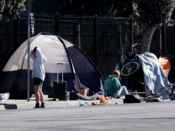
California has about 12 percent of the U.S. population, but about 45 percent of the country's unsheltered homeless population, at about 116,000 individuals. That is down from 124,000 in 2024, but up 7% from 2019, when Gavin Newsom took office as governor.
The authors make valid points about the need for transparency and accountability in tracking homelessness spending outcomes, and legitimately highlight audit findings showing inadequate data collection. However, their argument is significantly weakened by cherry-picking statistics that downplay recent improvements, employing loaded language like "homelessness-industrial complex" and "mindless spending," and misrepresenting "housing first" as ignoring mental health and addiction services when such programs typically include comprehensive wraparound support.
1. ad hominem • The authors imply that Governor Newsom's decision to sign a bill with a delayed transparency implementation date is motivated by self-interest (to avoid accountability during his tenure).
that bill won't make spending data public until 2027 -- conveniently, after his term ends.
This attack on Newsom's presumed motives, rather than a critique of the bill's actual provisions or potential practical reasons for the delay, serves to discredit his actions and character. It is specifically a circumstantial ad hominem.
2. straw man • The authors misrepresent the "housing first" strategy by characterizing it as treating housing as a "cure-all."
a failed "housing first" approach, which treats placement in supportive housing as a cure-all for the complex problem of homelessness,
This is a classic Straw Man because it exaggerates and distorts the typical "housing first" philosophy, which generally views stable housing as a crucial *foundation* or *prerequisite* for addressing other complex issues, not a complete and sole solution. The author constructs a simplified, extreme version of the argument that is easier to attack, rather than engaging with the more nuanced and robust arguments made by proponents of "housing first."
References
- Joshua Rauh, Benjamin Jaros (2026, Jan 27). How Gavin Newsom's California made homelessness worse.
https://nypost.com/2026/01/27/opinion/how-california-made-homelessness-worse/
Disclaimer
Note that there being one or more apparent fallacies in the arguments presented in this article does not mean that every argument the arguer made was fallacious, nor does it mean there are not other arguments in existence for the same or similar position that are logically valid. Also note that checking for fallacies is not the same as verification of the premises the arguer starts from, such as facts that the arguer asserts or principles that the arguer assumes as the foundation for constructing arguments. For more about this, see our 'What is Fallacy Checking?'
NO AI TRAINING
Without in any way limiting the author’s [and publisher’s] exclusive rights under copyright, any use of this publication to “train” generative artificial intelligence (AI) technologies to generate text is expressly prohibited. The author reserves all rights to license uses of this work for generative AI training and development of machine learning language models.
Comments