RFK Jr. Discusses His Appeal to Young Voters
Analyzing the article
 Newsweek


Our Analysis: 5 Fallacies
According to a recent Quinnipiac poll, I am leading in a three-way with President Biden and former President Trump among voters 18 to 34, and a New York Times/Siena poll shows me beating Biden and Trump among 18 to 44 year olds in six key battleground states.
Mainstream media often ask me why I enjoy such strong support from young voters. 1 Based on countless campaign trail conversations, I believe America's youth support me because I am offering them something that has been nearly lost over the last two presidential terms: hope for an America that lives up to its promises and ideals.
...
2 Young people are not satisfied with voting for the lesser of two evils. Their generation seeks an outsider like me who is running as an independent, given that 38 percent of the youngest voters aged 18 to 29 have no party affiliation, a higher percentage than identify as Democrats (35 percent) or Republicans (26 percent). Because they are repelled by the rancor and name-calling in two-party politics, they respond positively to my mission to "Heal the Divide."
...
I am also listening to young Americans who want the next president to wind down the war machine and instead invest in this country...
The disastrous war in Ukraine has already cost American taxpayers $111 billion, and Biden has been seeking another $60 billion. 3 Imagine if we invested that money in the next generation of Americans, instead of a brutal conflict that has claimed a generation of Ukrainian youth.
...
4 The tragic assassinations of my uncle, President John F. Kennedy, and my father, Senator Robert F. Kennedy, left an indelible scar on this country. Those national traumas engendered a feeling of existential loss, a blow to the very soul of the nation. Although the assassinations of the 1960s are ancient history to today's youth, still they intuitively understand that we could have taken a different, better path.
...
This sense of 5 indignation, betrayal, and perennial hope that animated the youth movement of the 1960s lives on today. On November 23, 1963, the day after the shocking assassination of President Kennedy, Bob Dylan performed his now iconic youth protest song, "The Times They Are A-Changin.'" His timeless anthem captured 5 the spirit of righteous anger and yearning for a better world that burned brightly in the youth culture of the 60s.
That flame still flickers today in the hearts of young Americans... I am doing my best to keep that flame alive for the next generation.
- Anecdotal reasoning • The author makes broad claims about the views and desires of young Americans based on anecdotal evidence from his campaign trail conversations. While he mentions poll data, relying solely on anecdotal evidence could lead to hasty generalizations about the beliefs of an entire generation.
- False Dilemma • The author presents a false dichotomy between his candidacy and the two major parties, suggesting that young voters are dissatisfied with only being able to choose between "the lesser of two evils." This frames a voter's decision as choosing between RFK Jr or the two Presidents (Biden and Trump), which oversimplifies the political landscape and ignores alternative candidates and parties that young voters may support, such as Nikki Haley or a No Labels candidate.
- False Dilemma • The author suggests that the US government must invest exclusively in war efforts or in building up the young generation, overlooking the possibility that with its large budget, the government may be able to invest in both.
- Appeal to emotion • The author appeals to the emotions of the audience by referencing the tragic assassinations of his uncle and father, suggesting a connection between those events and the current state of politics. This appeal to emotion may sway readers' opinions without providing substantive evidence.
- Appeal to emotion • The author uses a mix of positively and negatively loaded language, with phrases like "indignation," "betrayal", "hope", "righteous anger", and "yearning for a better world" to evoke strong sentiments in the reader which he implies should bend them toward supporting his candidacy. All of these emotions could be authentically present in young voters without their having to vote for RFK Jr. as a result.
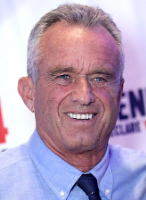
- Image Credit for byline image: Gage Skidmore
References
- Robert F. Kennedy Jr. (2023, Dec 20). RFK Jr.: Why So Many Young Americans Support My Presidential Campaign.
https://www.newsweek.com/rfk-jr-why-so-many-young-americans-support-my-presidential-campaign-opinion-1854242
Disclaimer
Note that there being one or more apparent fallacies in the arguments presented in this article does not mean that every argument the arguer made was fallacious, nor does it mean there are not other arguments in existence for the same or similar position that are logically valid. Also note that checking for fallacies is not the same as verification of the premises the arguer starts from, such as facts that the arguer asserts or principles that the arguer assumes as the foundation for constructing arguments. For more about this, see our 'What is Fallacy Checking?'
NO AI TRAINING
Without in any way limiting the author’s [and publisher’s] exclusive rights under copyright, any use of this publication to “train” generative artificial intelligence (AI) technologies to generate text is expressly prohibited. The author reserves all rights to license uses of this work for generative AI training and development of machine learning language models.
Comments